Is Polished Concrete Slippery ?

 Polished concrete is often assumed to be slippery because of its smooth, glossy appearance. In reality, properly polished concrete is not inherently slippery and can perform as well as - or better than - most common flooring surfaces like tiles and timber.
Whether polished concrete is slippery depends on surface finish, moisture conditions, and maintenance, not just how shiny the floor looks.
Why Polished Concrete Isn’t as Slippery as It Looks
Polished concrete achieves its finish through mechanical grinding and polishing, not by applying a topical coating. This process creates a dense, refined surface that provides consistent traction underfoot.
Unlike sealed tiles or coated floors, polished concrete:
- Does not rely on waxes or surface films
- Maintains micro-texture that contributes to grip
- Performs consistently when dry
A high-gloss finish reflects light, which can make the surface look slippery, even when it is not.
What Happens When Polished Concrete Gets Wet?
Like all hard flooring surfaces, polished concrete can become more slippery when wet. However, polished concrete generally performs better than many alternatives, such as tiles with surface sealers.
Slip resistance when wet is influenced by:
- The level of polish (low, medium, or high gloss)
- The presence of contaminants (water, oils, dust)
- Cleaning products used on the floor
In areas exposed to moisture, slip resistance can be improved through:
- Lower gloss finishes
- Anti-slip treatments
- Correct cleaning and maintenance practices
 Polished Concrete vs Other Flooring Types
Compared to common flooring options, polished concrete performs well:
- Polished concrete: Consistent traction, no coatings to fail
- Tiles: Can become very slippery when sealed or wet
- Epoxy coatings: Slip resistance depends on additives and wear
- Vinyl: Often more slippery when wet or contaminated
Because polished concrete does not rely on topical coatings, its slip performance remains more stable over time.
Slip Resistance and Australian Standards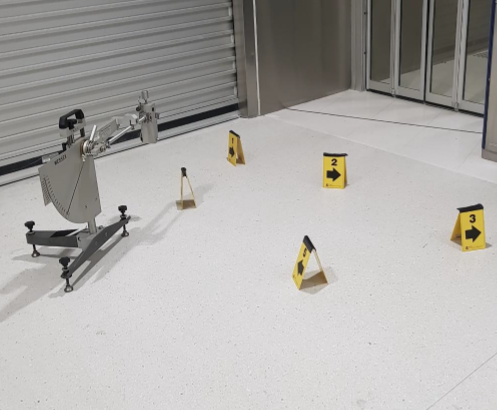
Slip resistance in Australia is assessed using recognised testing methods, including pendulum testing, which provides a P rating (P0–P5). This rating measures how slip-resistant a surface is, particularly in wet conditions.In addition, some environments—such as industrial, commercial kitchens, and high-risk work areas—may require an R rating (R9–R13). R ratings assess slip resistance under oil-contaminated conditions and are typically applied in workplaces rather than residential settings.Polished concrete floors can be tested, specified, and adjusted to achieve the appropriate P or R rating for their intended use. This may involve selecting the correct level of polish, applying slip-resistant treatments, or modifying maintenance practices.For commercial and public environments, slip resistance should always be assessed based on how the space is used, including foot traffic, moisture exposure, and cleaning regimes—not simply how glossy the floor appears.
How to Reduce Slip Risk on Polished Concrete
To minimise slip risk:
- Choose the appropriate gloss level for the space
- Use entrance mats to reduce moisture and debris
- Clean with neutral cleaners designed for polished concrete
- Avoid waxes or surface coatings
- Address spills promptly
In high-risk areas, additional slip-resistant treatments can be applied without compromising the appearance of the floor.
Is Polished Concrete Safe?
Yes—when correctly specified, installed, and maintained, polished concrete is a safe and practical flooring option for homes, commercial buildings, and industrial spaces.
For advice on selecting the right finish and slip resistance level, speak with the team at Diagrind.
Frequently Asked Questions (FAQ)
Is polished concrete slippery when wet?
Polished concrete can become more slippery when wet, similar to tiles or vinyl. However, its performance depends on the level of polish, surface condition, and cleanliness. Slip resistance can be improved with lower-gloss finishes or anti-slip treatments in wet areas.
Is polished concrete more slippery than tiles?
Not necessarily. Many tiles become very slippery when sealed or wet. Polished concrete often provides more consistent traction because it does not rely on topical coatings or waxes.
Can polished concrete be made slip resistant?
Yes. Slip resistance can be adjusted through the level of polish, surface treatments, and correct cleaning methods. Floors can also be tested to confirm slip ratings where required.
Does high-gloss polished concrete mean slippery?
No. Gloss level affects appearance, not traction. A high-gloss polished concrete floor may look slippery due to light reflection, but that does not automatically mean it performs poorly underfoot.
Industrial Concrete Floors

Industrial Concrete Floor Solutions for New Builds
 New industrial concrete floors are designed for strength and longevity, but at practical completion they often retain construction dust, surface laitance, curing residues, tyre marks, and light oils from site traffic and trades. If left untreated, these residues can lead to early dusting, reduced slip resistance, and higher ongoing maintenance costs once the building is occupied.
At Diagrind, we work directly with builders, developers, and project managers to deliver compliant, low-disruption concrete floor treatments that meet handover requirements without coatings, grinding, or major downtime.
Mechanical Floor Scrubbing
Mechanical floor scrubbing is a practical pre-handover solution for new warehouses, factories, and commercial units. Using industrial autoscrubbers, including Viper scrubbers, we remove surface contamination with a controlled combination of water and purpose-selected cleaning chemicals appropriate for new concrete.
This process:
- Removes construction dust and surface laitance
- Eliminates curing residues, tyre marks, and light oils
- Deep-cleans the slab prior to occupation
- Improves slip resistance for early use
- Prepares the floor for densifying and dustproofing
- Reduces future cleaning and maintenance demands
Scrubbing is carried out efficiently and safely, allowing other trades and inspections to proceed with minimal disruption.
Concrete Densifying & Dustproofing
Following scrubbing, concrete densifying provides long-term performance benefits. The densifier penetrates the slab and chemically hardens the concrete from within, creating a tighter, more durable surface.
Densifying:
- Significantly reduces concrete dusting
- Increases abrasion resistance for forklifts and pallet traffic
- Improves cleanability without forming a surface coating
- Provides a durable finish suitable for immediate occupancy
This treatment is commonly specified for new industrial units where performance, longevity, and low maintenance are priorities.
Why This Matters at Handover
From a builder and developer perspective, untreated concrete floors can become a handover issue, leading to post-completion complaints about dust, cleanliness, or surface wear.
 Pre-handover scrubbing and densifying:
- Presents a clean, professional floor at practical completion
- Reduces early-use wear and dust complaints
- Supports WHS expectations around slip resistance
- Minimises call-backs after tenant occupation
- Delivers a low-maintenance floor from day one
These solutions provide a cost-effective, specification-aligned finish that performs immediately and continues to improve over the life of the slab.
What is a Slip Rating
What polished concrete finish is right for me
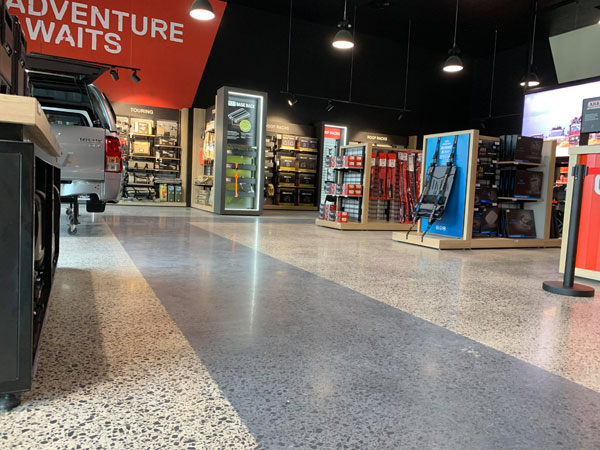
What polished concrete finish is right for me
This is a loaded question and ever house is different. So we thought we might put together a small list of pro's and con's to the major types..jpg)
First big difference is diamond polished or grind and seal.
- Pro Diamond polished:
- hard to scratch as no topical coating to scratch off
- able to achieve a variety of non-slip levels easily
- eco-friendly greener flooring option
- low lifetime cost
- easy to refurbish
- Con Diamond Polished:
- susceptible to acid etching
- susceptible to staining
- level of exposure and artefacts determined by the concreter who installs
- Pro Grind and Seal:
- often cheaper option
- very good staining resistance
- can achieve "wet look" polished concrete
- Con Grind and Seal:
- topical coating that can scratch
- achieving non-slip requires an additive that can detract from aesthetics or cause floor to wear prematurely
- harder to refurbish
The next major question to answer is the exposure of aggregate level
Burnished concrete/cream polish Class O and A):
- Pro:
- clean seamless finish
- natural looking and easier to colour match between different pours.
- cheapest and fastest diamond polished concrete floor
- Con:
- staining that occurs before polishing can be difficult to impossible to remove
- pattern and finish dictated by the quality of helicopter work when installed
- acid etching can be much more noticeable compared to floors with exposed aggregate.
- can really only be achieved on new builds
- small aggregate and fines can be exposed during the polishing process
- level of finish dictated by levelness of floor
Hit n Miss/partial aggregate exposure (Class B):
- Pro:
- industrial look
- works on most floors (sometimes due to installation majority of aggregate will need to be exposed)
- can sometimes hide artefacts from pouring.
- Con:
- level of exposure dictated by levelness of floor
Full exposure/platinum (Class C/D):
- Pro:
- will always level the floor out
- can grind out high spots and to allow for doors without affecting the look and finish
- terrazzo look to floor
- very high end finish
- Con:
- quality of exposure dictated by installation of concrete
- artefacts such as boot prints and screed marks can be seen.
- Cold joints in pour can be obvious
Different Types of Polished Concrete
There are so many different names givent to polished concrete it can be extremely confusing for example;
hiperfloor, superfloor, pyrafloor, hit n miss, burnished, surface polish, cream polish, salt n pepper, partial exposure, bronze, silver, gold, platinum, just to name a few........
At Diagrind (R) we have tried to simplfy the process and ignore all the fancy names which essentially mean the same thing. American standards (as we are yet to get Australian ones) break polished concrete into several classes
Class A: cream polish/burnished concrete
Class B: partial exposure
Class C/D: medium to full exposure
Class S (this is unique to Australia: grind and seal (varying levels of aggregate exposure)
There are no fancy names, this can be used by any propriatary polishing system. This way you know that you are getting what you asked for from your contractor. We provide free resources for you to use and give you contractor to descibe the type of polished concrete you want.
All of the forms are here